
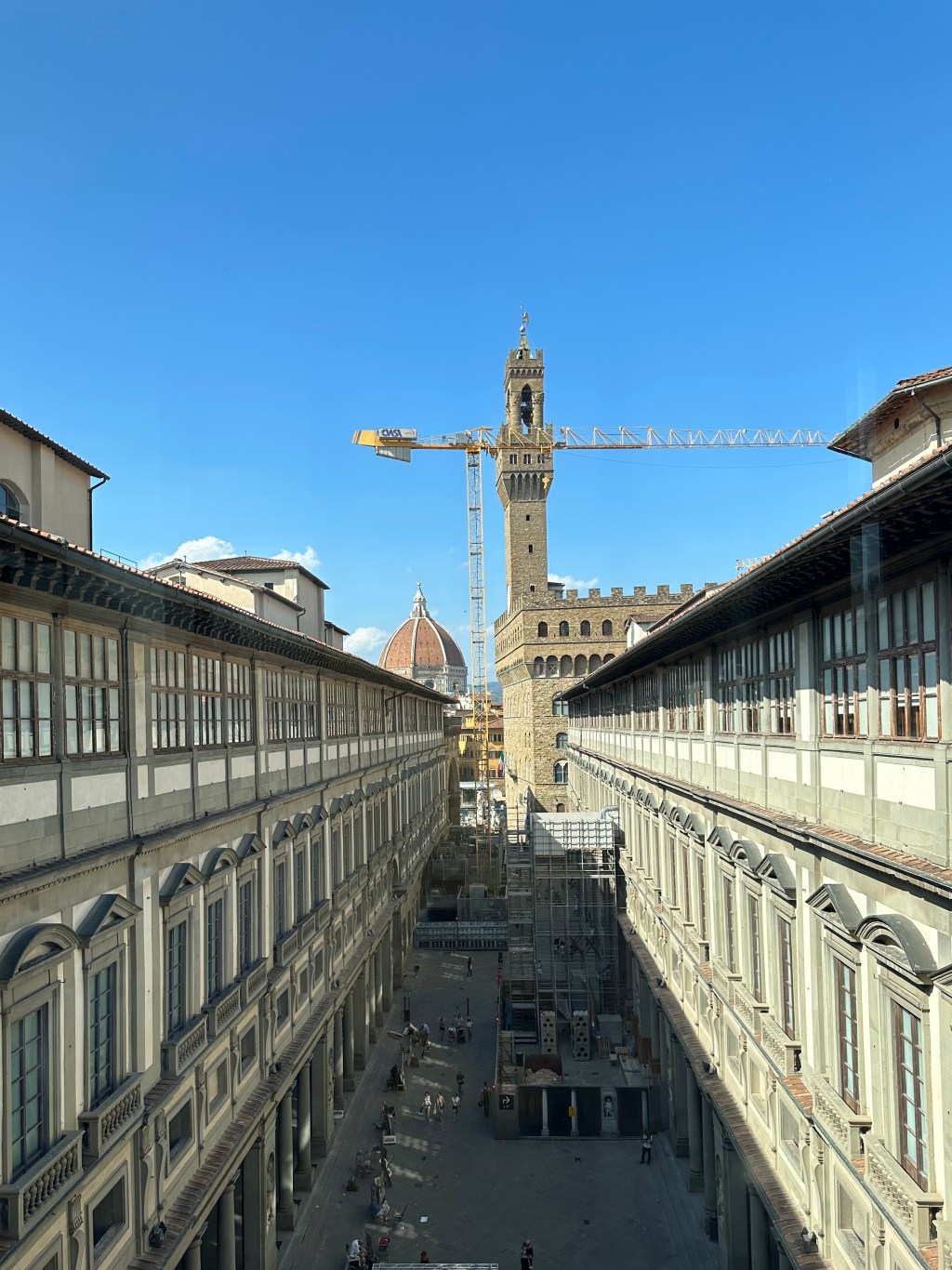
Summer Heat and Renaissance Art: First Steps into Uffizi
Joining a museum tour group wasn’t my plan – especially not in the middle of a Florence summer. As an art student who prefers quiet, unhurried observation, I usually avoid guided tours. But there I was, part of my summer camp program, stepping into the Uffizi Gallery with a group of twenty others. The unexpected twist? That guided tour turned out to be exactly what I needed.
Florence’s July heatwave had driven what felt like half the city’s tourists into the air-conditioned sanctuary of the museum. Moving through the former offices of the Medici family – that’s what “Uffizi” means in Italian – I began to appreciate our guide’s expertise in navigating the crowds. The building itself told stories of power and art patronage. Its massive corridors and endless rooms, once bustling with Renaissance-era administrators, now housed the Medici’s private collection, permanently bound to Florence by the family’s final wish.
Scale and Detail: Beyond the Textbook
My art history textbook hadn’t prepared me for this. Each gallery revealed familiar masterpieces, but they were nothing like their printed versions. The sheer size of these works changed everything – what looked like simple brush strokes in books transformed into intricate details that pulled me closer to each canvas.
Moving from room to room, I found myself re-learning what I thought I knew about Renaissance art. Botticelli’s “Birth of Venus” wasn’t just about classical mythology and precise technique – it was about the way light seemed to dance across Venus’s skin, creating an almost ethereal glow that no reproduction had ever captured. In Raphael’s “Madonna of the Goldfinch,” the careful triangular composition I’d studied in class took on new meaning. Standing before it, I could see how this geometric arrangement wasn’t just academic theory – it naturally drew my eye from the children at the base to Mary’s gentle face, creating a sense of harmony I’d never fully appreciated in reproductions.
These weren’t just examples of Renaissance perspective and realism anymore – they were windows into the artists’ world, showing me exactly why this period revolutionized Western art. Standing before these works, I understood why my professors always insisted we visit museums whenever possible. Some things just can’t be taught through textbook pages.
Two Ways of Seeing: Da Vinci’s Annunciation
The same biblical scene, yet worlds apart. After seeing Simone Martini’s medieval Annunciation near the entrance, Da Vinci’s version made me forget about following the group. Our guide had moved on to the next room, but I lingered, trying to absorb every detail of this massive work. The sheer scale made me step back – these weren’t just paintings to be hung in quiet chapel corners anymore.
My eyes kept moving between the crisp details of Mary’s reading room and the misty mountains in the distance. Da Vinci didn’t just paint what he saw – he painted the way our eyes actually see, with nearby objects sharp and clear, distant ones softening into blue haze. Standing there, I thought about the patience it must have taken to build these layers of tempera paint, slowly bringing this vision to life.
Even with our guide gesturing for me to join the group, I couldn’t help but wish for more time. These two Annunciations – Martini’s and Da Vinci’s – showed me more about the evolution of Renaissance art than any lecture could have. One painting left on my list to research more thoroughly when I got home.
A Final Gallery: The Path Home
Emerging from the air-conditioned galleries into Florence’s thick summer heat, I found one last surprise. The path to Piazza della Signoria doubled as an open-air gallery – a line of marble figures stood like silent guardians. Leonardo, Michelangelo, da Vinci, and other Renaissance masters whose works I’d just seen inside now watched over the tourist crowds in stone form. Even exhausted from hours of art viewing, I had to smile at how Florence turns every space, even an exit route, into a chance to connect with its artistic legacy.
 Gallery Tales: Monica Yoon Art Journey
Leave a comment