
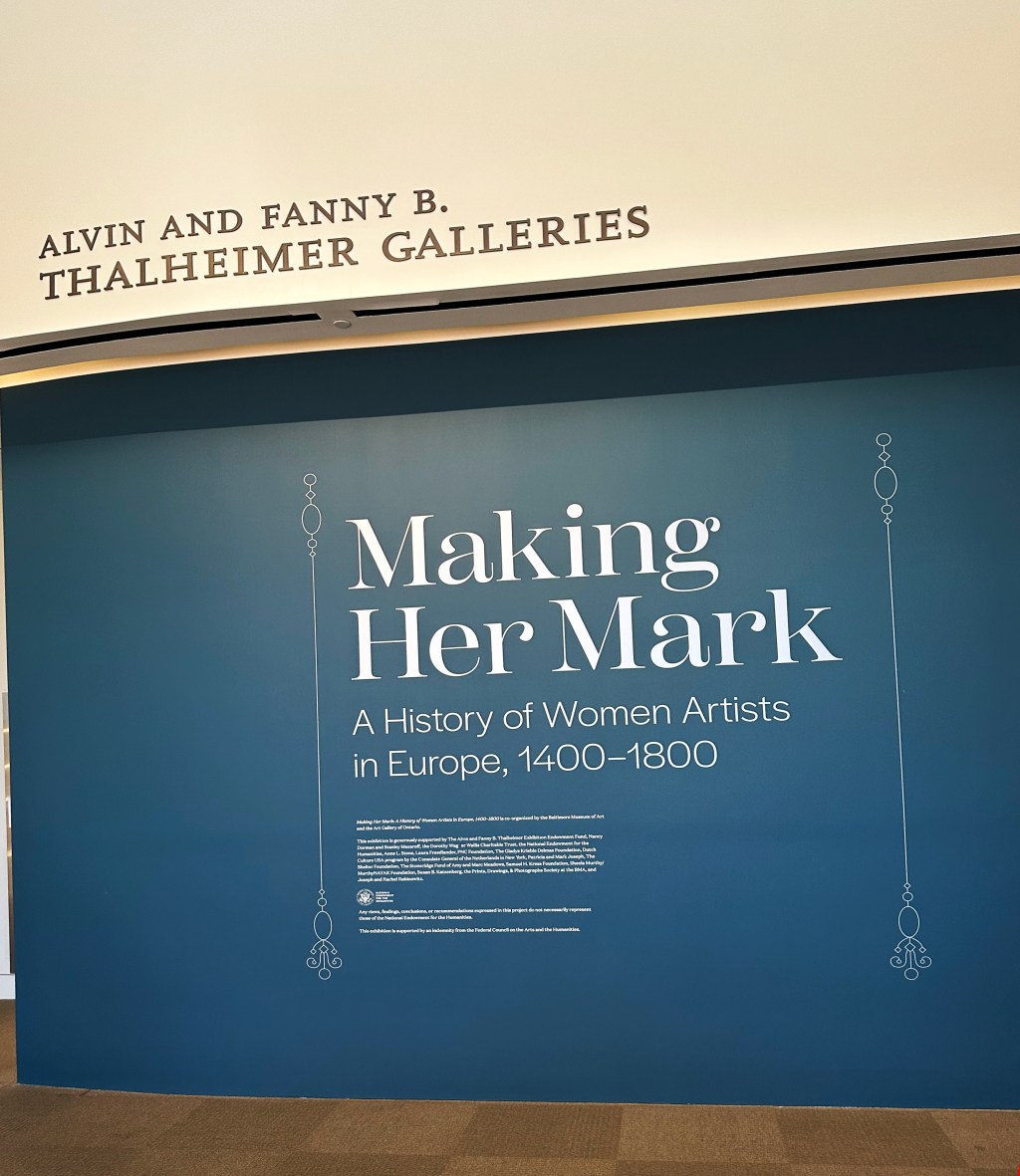
Making Her Mark: A Journey of Discovery
Art exhibitions sometimes find us when we least expect them. As an art student, I occasionally seek out specific shows, but more often, it’s an unexpected title that sparks curiosity and leads to discovery. The Baltimore Museum of Art’s “Making Her Mark” caught my attention this way. The moment I heard about it, a simple realization struck me: while women’s creative voices dominate contemporary art, my Western art history textbooks had been conspicuously quiet about their historical predecessors, much like the classical music canon before our time.
This curiosity prompted an impromptu trip to Baltimore with my mother. The museum’s imposing structure stands as a cultural anchor in a city showing its age. On this weekday afternoon, both the neighborhood and the museum halls were surprisingly quiet. While such sparse attendance might concern an administrator, it offered me a rare gift – the space and time for undisturbed contemplation.
Between Haste and Wonder: A Journey to the Exhibition
The museum’s grand lobby sets an unexpected tone – instead of traditional chandeliers, a contemporary light installation ripples overhead like an aurora, bridging classical and modern sensibilities. Beyond, Rodin’s “The Thinker” emerges against the backdrop of an expansive indoor garden, our solitary footsteps echoing in the empty halls.
The American Modern galleries unfold in carefully layered displays reminiscent of Boston’s Museum of Fine Arts, though with a distinct local pride – each label reveals connections to Maryland’s artistic legacy. This regional focus adds an unexpected intimacy to the impressive collection. In the Impressionist room, Monet’s Waterloo Bridge series captures London’s misty urban atmosphere, their characteristic play of light stopping me in my tracks. Quick photographs, then discoveries: lesser-known but unmistakable works by Van Gogh and Gauguin, their signature styles evident in every brushstroke. The Van Gogh landscape, though not among his famous works, carries his distinctive touch in each painted blade of grass.
Moving through galleries of early 20th-century European paintings, past the intriguingly titled “How Do You Know World” modern art exhibition, and rooms dedicated to African and Oceanic art, my purposeful stride toward the special exhibition keeps slowing. What started as a quick day trip from New York to see “Making Her Mark” has turned into a constant negotiation between time and curiosity. The Baltimore Museum of Art, it seems, demands more than a hasty visit.
Making Her Mark: The Quiet Revolution
Finally reaching the special exhibition wing, I discovered something far beyond my expectations of a painting exhibition. There was a comprehensive celebration of women’s creative expression – from paintings and ceramics to scientific illustrations and needlework. What connects these diverse mediums is an extraordinary attention to detail that speaks volumes about their creators’ dedication.
The Renaissance-era paintings particularly captivate me. The rendering of silk fabric is so precise that my fingers instinctively want to verify its texture. This isn’t merely technical skill – it’s evidence of countless hours of patient observation and execution. Standing before the wall text “Silent Labor,” I realize this exhibition isn’t about historical gender inequality, but rather a testament to artistic resilience. As an art student today, freely pursuing my passion, these works carry a different weight.
The “Women in Garden” section reveals another layer of precision – botanical illustrations detailed enough to serve as scientific documentation. In one piece, even the breathing pores of a dragonfly resting on a flower petal are meticulously rendered. Among these masterworks, a portrait of a Black woman in white silk draws particular attention, her buttons so precisely painted they seem ready to be fastened. This rare portrayal of a servant as the main subject offers a glimpse into another kind of artistic boundary-crossing.
My mother’s gentle reminders about our drive back to New York finally pulled me away, but not before I acquired the exhibition catalog. The opening line stops me mid-step: “The notion of the ‘exceptional’ woman artist may be one of the most insidious means of undermining the likelihood of women’s entering the creative arts.” – The art historical canon: Sins of omissions. This seems like reading is better saved for home when I can give it proper attention. The only regret? That this isn’t a Manhattan exhibition I could visit again easily.


Leave a Reply