Whitney Biennial 2024: A Student’s Perspective
The Whitney Biennial has returned after a two-year hiatus. As a high school art student selected for this semester’s Whitney Youth Insight afternoon program, I had the opportunity to visit the exhibition right after its opening. Contemporary art often challenges me – while I’m still learning to analyze and understand traditional art forms, the diverse mediums and unrestricted expressions of modern art frequently feel unfamiliar. The Biennial, known for addressing how art reflects current social and political realities, seemed particularly daunting. Yet I decided to focus less on individual pieces and more on their collective message.
I was puzzled when I heard the exhibition title “Even Better Than the Real Thing.” Would it feature AI-generated art? Was realism the theme? The curator’s note revealed a deeper meaning: an exploration of how our modern world, where virtual reality, digital technology, and media dominate our daily lives, creates “perfect” virtual experiences that seem to surpass reality itself. The exhibition questions the authenticity of our daily experiences – how real is our reality, and how is this truth being distorted? A complex theme, especially for someone still learning to navigate the contemporary art world.
The Art of Earth and Power
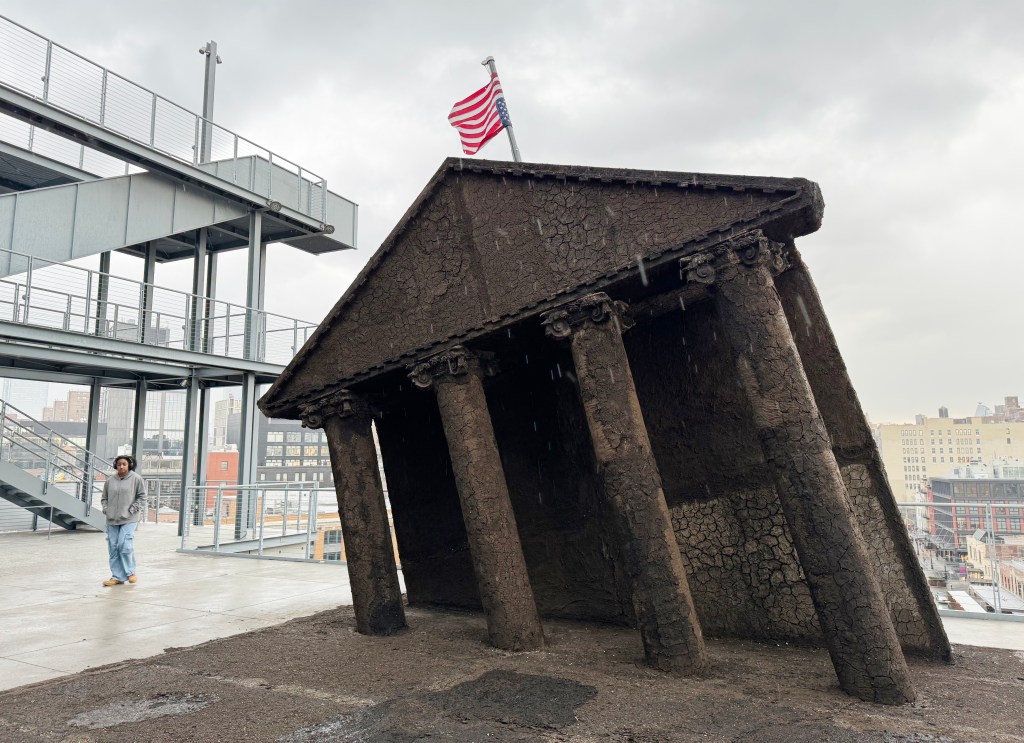
While the exhibition’s theme felt challenging to grasp, I was truly amazed by one piece. Kiyan Williams’ “Ruins of Empire II,” installed on Whitney’s outdoor terrace garden, presents an enormous tilting White House made entirely of soil. I moved closer to this massive structure, fascinated by how it dominated the terrace. How did the artist work with soil at this scale? Would it hold up in rain? The White House, a subject usually reserved for political discourse, transformed here into something entirely different – sinking, yet monumental. Perhaps Williams is suggesting that to create something “better than the real thing,” we first need to understand what’s real.
Then came the unexpected news: as part of the Youth Insight program, we would meet artists behind the exhibitions, and Kiyan Williams would be visiting our class in two weeks! Had someone overhead my curiosity on the rooftop? (I wondered, half-jokingly). Walking home that day, I felt a mix of gratitude and excitement – finally, I could ask about all these technical questions that had been running through my mind.
 Gallery Tales: Monica Yoon Art Journey
Leave a comment