
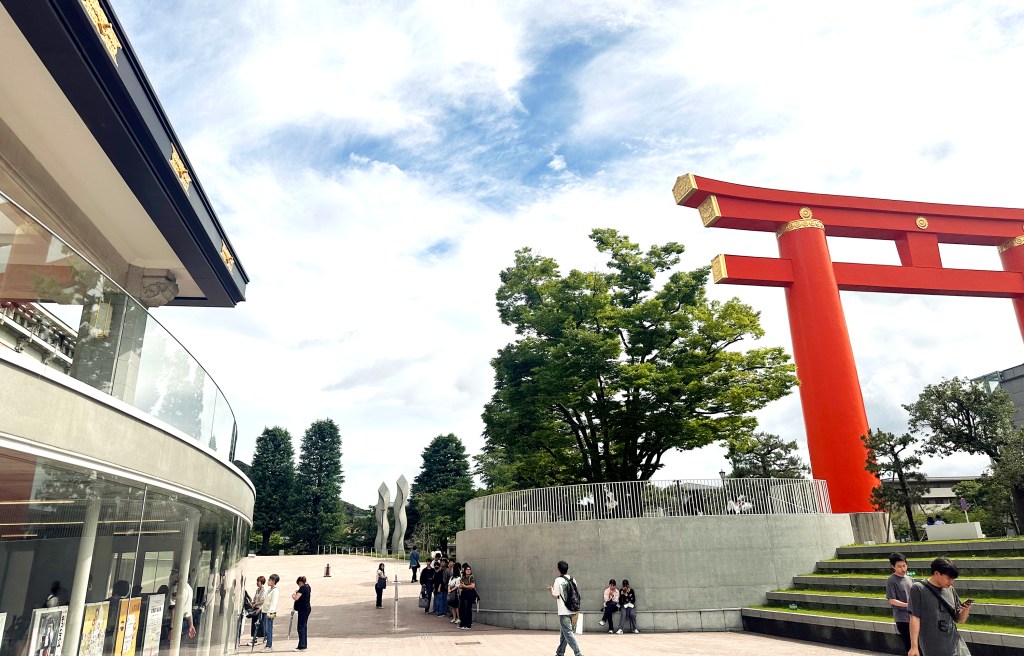
Where Past Meets Present
The Kyoto City KYOCERA Museum of Art stands as a testament to Japan’s artistic evolution. Built in 1933 as the Imperial Coronation Memorial Museum, the building itself tells a story of transformation. From the outside, classic Japanese architectural elements reign, but step inside and any expectations of traditional aesthetics are immediately shattered.
The three-story lobby, as I encountered it in summer 2023, made an immediate impact with its bold contemporary presence. Two massive Murakami Takashi figures dominated the soaring space, while one of his signature pop art pieces spread across the vast wall, filling the classical interior with his characteristic vivid colors. In one corner, Ghibli film posters and figurines added another layer of modern Japanese visual culture. This dramatic contrast between the museum’s historic exterior and its audacious lobby perfectly embodied Japan’s ability to embrace both heritage and contemporary expression.
The renovation works its own magic beyond the lobby. Unlike many updated historic buildings that simply overlay modern elements, here the old and new engage in constant dialogue. Having explored numerous renovated museums in New York, I find this balance particularly striking – neither element overshadows the other, creating instead a uniquely harmonious space.
Cubes in Kyoto: An Unexpected Revolution
Finding a comprehensive Cubism exhibition in Kyoto feels like discovering a hidden chapter of art history. While Picasso exhibitions are common in major museums worldwide, “The Cubist Revolution” offers something different – a deep dive into a movement I thought I knew from countless New York museum visits. The revelation that Japan served as a major debut stage for Cubist artists adds another layer to this unexpected encounter.
Delaunay’s “La Ville de Paris” emerges as the exhibition’s standout piece. While its structure echoes Picasso’s “Les Demoiselles d’Avignon,” Delaunay takes a more approachable path. His striking red Paris cityscape, with the Eiffel Tower rising through fractured planes, offers a more digestible interpretation of Cubist principles. The early Cubist works speak clearly enough, but as the exhibition progresses toward later pieces, the language becomes increasingly abstract – a reminder that some artistic revolutions are meant to challenge rather than comfort.
Beyond Pop: Rethinking Murakami
I’ve always approached pop art in museums with a degree of skepticism, especially in traditional art spaces. There’s often something jarring about seeing cartoon-like figures and bright commercial aesthetics in halls built for classical masterpieces. Yet Murakami’s exhibition at Kyocera challenged my preconceptions.
In a dedicated gallery space, his work revealed unexpected depths. A massive panoramic piece immediately caught my attention – a contemporary take on traditional Japanese scroll paintings. Where ancient artists might have depicted scenes of daily life in the capital, Murakami created a sprawling urban landscape punctuated by his signature flowers and contemporary figures, all rendered on a golden background reminiscent of Edo-period screens. In another striking work, his interpretation of traditional tiger paintings transformed the fierce feline subjects into a gathering of stylized creatures, their eyes and patterns echoing both manga aesthetics and classical Japanese brush techniques. These weren’t just pop culture references – they were thoughtful reinterpretations of Japan’s artistic heritage.
The museum’s garden revealed another side of Murakami’s art. His signature golden flower figures stood in the carefully maintained traditional Japanese landscape – not trying to mimic the elegance of European bronze sculptures, but creating their own contemporary dialogue with the space. The sight of rain falling on centuries-old moss while gleaming off the modern golden sculptures made me think differently about pop art in traditional settings. Perhaps this is exactly how art should evolve – not by replacing tradition, but by finding new ways to converse with it. In Kyocera Museum, Murakami’s work didn’t feel like an intrusion into a classical art space, but rather a natural continuation of Japan’s artistic journey.
 Gallery Tales: Monica Yoon Art Journey
Leave a comment